
Have you ever known something logically but struggled to feel it emotionally? You may know that everyone won’t like you, yet one person’s disapproval can leave you questioning your worth.
Cognitive Behavioral Therapy, or CBT, helps you recognize how your thoughts, feelings, and behaviors influence one another—and how to change patterns that keep you stuck.
How does CBT work?
The meaning we give a situation can affect how we feel and what we do next. Those behaviors can then reinforce our original thoughts, creating a cycle. CBT helps you recognize that cycle and find opportunities to respond differently.
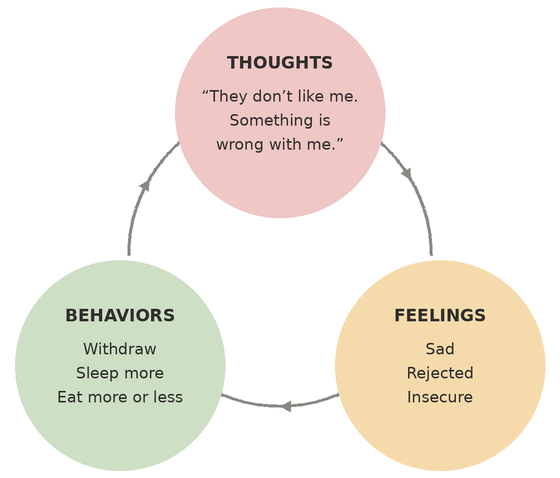
Let’s say someone doesn’t like you. Your first thought might be:
“Something must be wrong with me. I’m not good enough.”
You may feel sad, rejected, or insecure. You might withdraw from friends, sleep more, or eat more or less than usual. Pulling away can leave you feeling more alone, making your original thought seem even more believable.
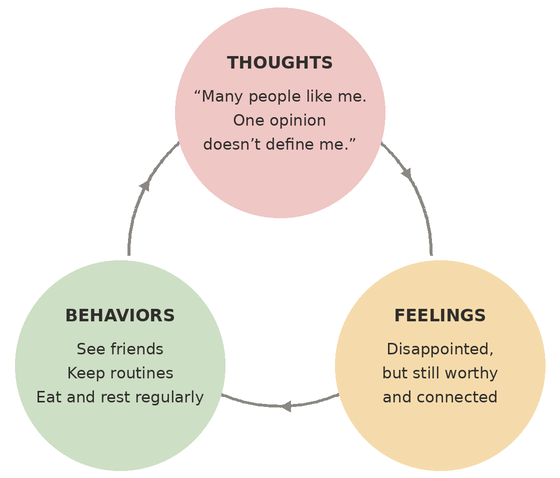
Now consider a more balanced thought:
“Most people in my life like and appreciate me. This person doesn’t care for me, and that’s disappointing, but their opinion doesn’t determine my worth.”
You may still feel hurt, but you’re more likely to stay connected with supportive people, keep your routines, and take care of yourself.
Here is how those two patterns can look:
Recognizing irrational and rational thoughts
CBT helps you identify irrational or unhelpful thoughts, examine the evidence, and develop a more rational, balanced perspective.
In this example, “This person doesn’t like me” may be accurate. The conclusion to question is, “Therefore, something is wrong with me.”
A thought can feel convincing without telling the whole story. We can pause and ask:
- Am I allowing one person’s opinion to define my worth?
- What evidence supports this thought? What evidence am I overlooking?
- What would I say to someone I love in this situation?
- What is one helpful action I can take while I’m feeling disappointed?
Sometimes a concern is accurate, and the next step involves solving a problem or setting a boundary. Other times, we need to reconsider an assumption or practice tolerating uncertainty.
You can feel disappointed by someone’s opinion and still trust your worth. CBT helps you practice that understanding through both your thoughts and your actions.
